Fudge Stirring Calculator
Fudge Temperature Guide
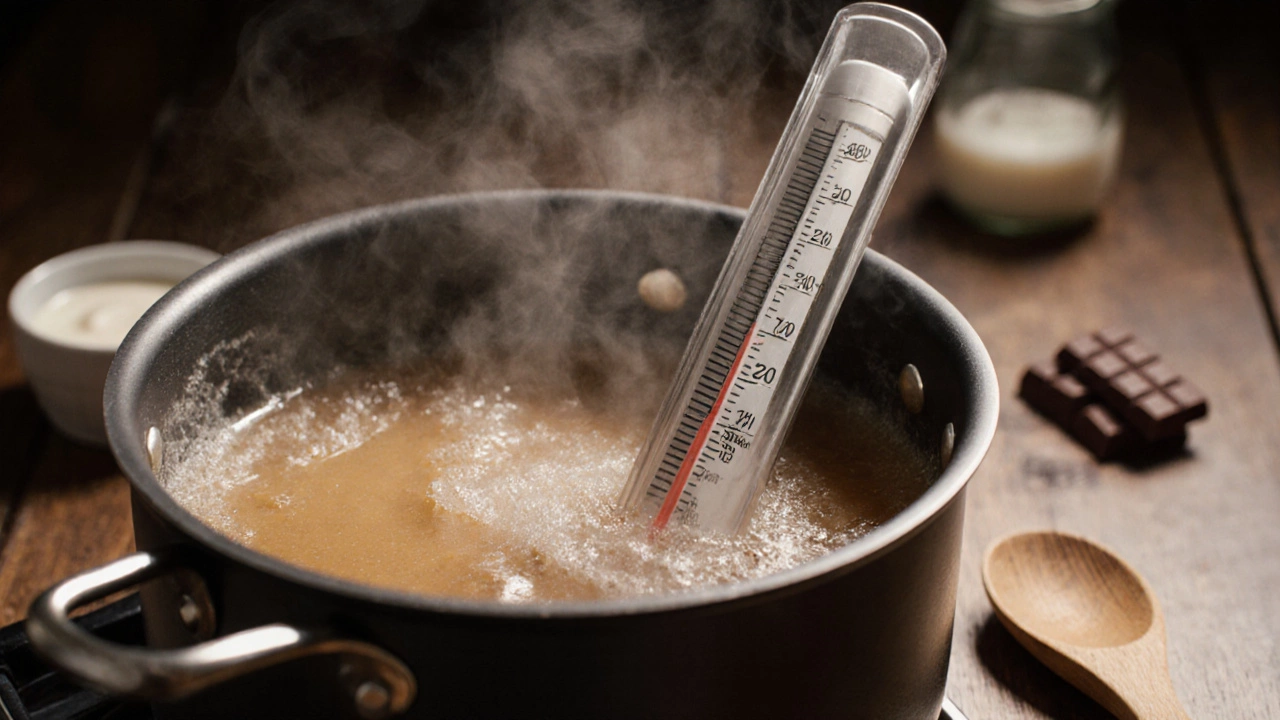
The ideal temperature to stir fudge is 110°F (43°C). Stirring too early causes graininess, while stirring too late creates uneven texture.
Stirring fudge isn’t just about mixing ingredients-it’s the difference between smooth, melt-in-your-mouth fudge and a grainy, crumbly mess. If you’ve ever made fudge and ended up with something that tastes fine but feels like sand in your mouth, you’re not alone. Most people over-stir it, under-stir it, or stir it at the wrong time. The truth? You only need to stir fudge once, and only after it’s cooled just right.
Why Stirring Fudge Wrong Ruins Everything
Fudge is a sugar crystal control game. When you heat sugar, water, and milk (or cream) to around 234°F (112°C), you create a supersaturated sugar solution. As it cools, those sugar molecules want to form crystals. Too many crystals? Grainy fudge. Just the right tiny ones? Silky smooth. Stirring too early-while the mixture is still hot-triggers crystal formation all at once. It’s like shaking a soda bottle before opening it. The sugar rushes to form crystals everywhere, and you end up with a texture more like crushed rock than dessert. This is why every fudge recipe tells you to leave it alone after taking it off the heat. It’s not being lazy. It’s science.The Right Time to Stir Fudge
Wait until the fudge mixture has cooled to about 110°F (43°C). That’s the sweet spot-warm enough that the sugar is still liquid enough to move, but cool enough that crystals won’t form uncontrollably. How do you know when it hits that temperature? Use a candy thermometer. Don’t guess. If you don’t have one, drop a small spoonful of the mixture into a glass of cold water. If it forms a soft ball that flattens when you pick it up, you’re close. But for fudge, thermometer accuracy matters. A 10-degree difference can change the texture. Once it hits 110°F, that’s your cue. Add your vanilla, chocolate, butter, or nuts. Then stir-slowly, steadily, and only until it starts to lose its shine. That’s it. Usually 2 to 5 minutes. No more.What Happens If You Stir Too Much?
Stirring past the point where it loses its gloss? You’re forcing sugar crystals to grow. The fudge will turn grainy, dry, and crumbly. It might still taste sweet, but it won’t melt on your tongue. It’ll crumble like a poorly made shortbread. I’ve seen people stir fudge for 15 minutes, convinced they’re “working it in.” That’s not a technique-it’s a mistake. The longer you stir after cooling, the more crystals form. It’s like stirring oatmeal too long and turning it into glue. One real-world example: A baker in Brighton made fudge for a Christmas market and stirred it continuously while it cooled. She sold 30 bars. Only 3 people came back for more. The rest said it felt like eating sugar grit. She didn’t know why-until she read about the science of fudge.
What Happens If You Don’t Stir at All?
Not stirring at all? That’s not ideal either. You need to mix in flavorings and fats evenly. If you skip stirring entirely, your vanilla might sink to the bottom. The butter might pool on top. The chocolate won’t distribute. You’ll get uneven bites-some too sweet, some too greasy. The goal isn’t to stir for texture. It’s to stir for even distribution. Once everything’s blended and the fudge starts to thicken and dull, stop. Pour it into the pan. Let it set undisturbed.Tools That Help (and Tools That Don’t)
Use a wooden spoon or silicone spatula. Metal spoons can conduct heat too quickly and cause uneven cooling. Plastic can melt if the fudge is still too hot. Don’t use a hand mixer or stand mixer. The agitation introduces air and creates unwanted crystal nuclei. You’re not making whipped cream-you’re making fudge. Less is more. And never scrape the sides of the pot while it’s cooking. Those sugar crystals clinging to the sides? They’ll fall into the mixture later and act as seed crystals. That’s why some recipes say to brush the sides with a wet pastry brush while cooking. It dissolves stray crystals before they can cause trouble.
Pro Tips for Foolproof Fudge
- Use heavy cream, not milk. Higher fat = smoother texture.
- Don’t double the recipe. Larger batches cool unevenly and are harder to control.
- Line your pan with parchment paper. No need to grease it-fudge doesn’t stick if you do it right.
- Let it set at room temperature. Don’t put it in the fridge to speed things up. Cold air causes condensation and can make the surface sticky.
- Cut it with a sharp knife dipped in hot water. Wipe the blade between cuts for clean edges.
Common Fudge Mistakes (and How to Fix Them)
- Grainy fudge? You stirred too soon. Next time, wait until 110°F.
- Too soft? You didn’t cook it to 234°F. Use a thermometer next time.
- Too hard? You cooked it past 240°F. Fudge should be in the soft-ball range.
- Oil separated? You stirred too much after cooling, or used low-quality chocolate. Stick to high-cocoa chocolate bars, not chips.
How Often Should You Stir Fudge? The Answer
You stir fudge once. After it cools to 110°F. For 2 to 5 minutes. Then you stop. No more stirring. No more checking. No more second-guessing. It’s not about frequency. It’s about timing. And patience. Fudge doesn’t need your constant attention. It needs you to trust the process. If you follow this, your fudge will be smooth, rich, and deeply satisfying. People will ask for the recipe. They won’t ask why it’s grainy. And you’ll know exactly why: because you didn’t stir it too much.Can I stir fudge while it’s still hot?
No. Stirring fudge while it’s hot (above 110°F) causes sugar crystals to form too quickly, leading to a grainy texture. Wait until the mixture has cooled to 110°F before stirring.
Why does my fudge turn out crumbly?
Crumbly fudge usually means you stirred too much after it cooled. Over-stirring encourages large sugar crystals to form. Stop stirring as soon as the fudge loses its glossy shine-usually after 2 to 5 minutes.
Do I need a candy thermometer to make fudge?
Yes, for consistent results. Fudge needs to reach exactly 234°F (112°C) during cooking. Without a thermometer, it’s easy to undercook or overcook it, which affects texture. A digital thermometer costs less than £10 and is worth it for fudge.
Can I use chocolate chips instead of chopped chocolate?
You can, but it’s not ideal. Chocolate chips are made with stabilizers to hold their shape, which can make fudge greasy or waxy. Use a high-quality chocolate bar chopped into pieces-it melts smoother and tastes better.
How long does homemade fudge last?
Stored in an airtight container at room temperature, fudge lasts about 2 weeks. If you want it longer, refrigerate it for up to a month, but bring it back to room temperature before eating for the best texture.
Popular Posts

Is Heinz Ketchup Suitable for Vegans?
Oct, 22 2024