
Fudge Soft Ball Stage Calculator
Stop guessing. The clock is a liar when you are making fudge, which is a dense confection made from sugar, butter, and milk or cream that requires precise heating to achieve the right texture. You might have heard that it takes exactly four minutes or seven minutes to reach the soft ball stage. That advice is dangerous. If your stove is electric instead of gas, if your pan is copper instead of stainless steel, or if you live in a humid coastal city like Brighton where the air holds more moisture, those minutes become meaningless.
The only thing that matters is temperature. Specifically, you need to hit 235°F (113°C). This is the magic number for the soft ball stage. At this exact point, the sugar concentration is just right to create a creamy, melt-in-your-mouth texture rather than a hard rock or a runny mess. In this guide, we will break down why time fails you, how to use a thermometer correctly, and what to do if you don’t own one.
Why Time Is a Bad Metric for Cooking Sugar
Sugar behaves differently depending on your environment. When you boil a mixture of water and sugar, you are essentially evaporating the water until the remaining syrup reaches a specific density. The rate at which water evaporates depends on heat intensity, pan surface area, and atmospheric pressure.
- Heat Source: A powerful induction cooktop boils off water much faster than a gentle gas flame.
- Pan Material: Copper conducts heat rapidly and evenly, while thick-bottomed stainless steel retains heat longer but heats up slower.
- Altitude: If you live above sea level, water boils at a lower temperature, meaning it takes longer to evaporate enough water to concentrate the sugar. For every 500 feet above sea level, the boiling point drops by about 1°F.
- Humidity: High humidity slows evaporation because the air is already saturated with moisture.
This is why following a timer is risky. One minute too long can push your fudge into the firm ball stage (240°F-245°F), resulting in a grainy, brittle treat. One minute too short leaves you in the thread stage, and your fudge will never set. Trust the science, not the stopwatch.
Understanding the Soft Ball Stage
In candy making, stages are defined by temperature ranges. The soft ball stage occurs between 234°F and 240°F (112°C-116°C). It is called "soft ball" because if you drop a small amount of the hot syrup into cold water, it forms a soft, pliable ball that flattens when you pick it up out of the water.
| Stage Name | Temperature (°F) | Temperature (°C) | Resulting Texture |
|---|---|---|---|
| Thread Stage | 215°F - 230°F | 102°C - 110°C | Thin threads form in water; too wet for fudge |
| Soft Ball Stage | 234°F - 240°F | 112°C - 116°C | Soft, pliable ball; ideal for fudge |
| Firm Ball Stage | 245°F - 250°F | 118°C - 121°C | Firm ball that holds shape; good for marshmallows |
| Hard Crack Stage | 300°F - 310°F | 149°C - 154°C | Brittle strands; used for lollipops |
For classic vanilla or chocolate fudge, aiming for the middle of the soft ball range-around 237°F (114°C)-is usually the safest bet. This ensures the final product is tender but still holds its shape when cut.
The Best Tool: A Candy Thermometer
If you want consistent results, invest in a candy thermometer, which is a specialized kitchen tool designed to measure high temperatures in sugar syrups accurately. There are two main types:
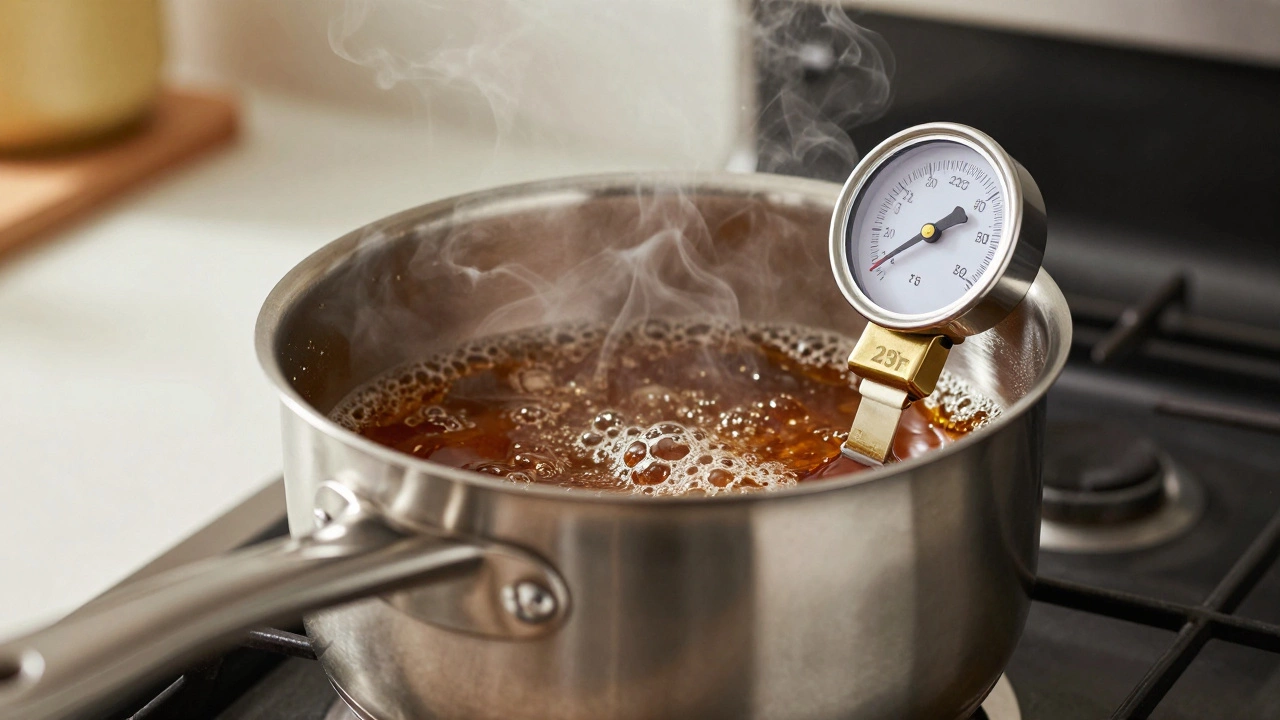
- Dial Thermometers: These clip onto the side of the pot. They are affordable and easy to read, but they can be less accurate if not calibrated properly.
- Digital Instant-Read Thermometers: These offer quick readings but require you to dip them in periodically. Ensure the probe does not touch the bottom of the pan, as that reads the metal temperature, not the liquid.
Regardless of the type, accuracy is key. Before you start cooking, test your thermometer. Bring a pot of water to a rolling boil. At sea level, it should read 212°F (100°C). If it reads 215°F, subtract 3°F from all your future candy readings. If it reads 209°F, add 3°F. This simple calibration step saves countless batches of ruined fudge.
How to Test Without a Thermometer
Not everyone owns a candy thermometer. That’s okay. You can use the "cold water test," also known as the spoon test. Here is how to do it safely:
- Fill a small bowl with ice water and place it next to the stove before you start cooking.
- Once your syrup has been boiling for several minutes, dip a clean metal spoon into the mixture.
- Lift the spoon and let a few drops fall into the ice water.
- Wait 10 seconds, then fish the drop out with your fingers.
If the drop forms a soft ball that squishes easily between your thumb and forefinger, you have reached the soft ball stage. If it dissolves back into liquid, keep boiling. If it forms a hard, rigid ball that doesn't flatten, you’ve gone too far. Be careful-the syrup is extremely hot and can cause severe burns.
Step-by-Step: Boiling Fudge to Perfection
Here is the reliable process for getting your fudge to the right stage every time. We will use a standard recipe ratio of 2 cups sugar, 1 cup milk, and ½ cup butter.
- Combine Ingredients: Add sugar, milk, and butter to a heavy-bottomed saucepan. Stir over medium heat until the sugar dissolves completely. Do not rush this step; undissolved sugar crystals can cause graininess later.
- Add Flavorings: Once dissolved, remove the pan from heat briefly and stir in vanilla extract or cocoa powder. Adding these after the initial dissolve prevents burning delicate flavors.
- Attach Thermometer: Clip your thermometer to the side of the pan, ensuring the tip is submerged in the liquid but not touching the bottom.
- Boil Unstirred: Return the pan to medium-high heat. Do not stir the mixture again. Stirring introduces air and encourages crystallization, which leads to gritty fudge. Let it boil vigorously.
- Monitor Temperature: Watch the thermometer closely. As the water evaporates, the temperature will rise slowly at first, then more quickly. When it approaches 230°F, reduce the heat slightly to avoid overshooting.
- Hit the Target: Remove the pan from heat immediately when the thermometer reads 235°F-237°F (113°C-114°C).
- Cool and Beat: Let the mixture cool to 110°F (43°C) without stirring. Then, beat it vigorously with a wooden spoon until it thickens and loses its glossy shine. This is when the sugar crystals form properly.
- Pour and Set: Pour the fudge into a buttered pan and let it set at room temperature for 2-4 hours before cutting.
Troubleshooting Common Issues
Even with the right temperature, things can go wrong. Here is how to fix common problems.
Grainy Fudge: This happens when large sugar crystals form. It is often caused by stirring the mixture during the boiling phase or having undissolved sugar at the start. To prevent this, ensure all sugar is dissolved before boiling and avoid agitation once the boil starts. Some recipes add a tablespoon of corn syrup, which interferes with crystal formation and keeps the fudge smooth.
Runny Fudge: If your fudge never sets, you likely stopped boiling too early. You didn’t evaporate enough water, so the sugar concentration was too low. Unfortunately, you cannot fix this batch. However, you can reheat it, boil it to the correct temperature, and try again. Just be mindful that the ingredients may darken slightly.
Hard Fudge: If your fudge is like a rock, you boiled it too long. You passed the soft ball stage and entered the firm ball or hard crack stage. While you can’t soften it, you can crumble it and use it as a topping for ice cream or mix it into cookie dough.
Pro Tips for Consistent Results
- Use a Heavy Pan: A thick-bottomed saucepan distributes heat evenly, preventing hot spots that can burn the sugar at the bottom while the rest remains undercooked.
- Wash Down the Sides: During boiling, sugar splashes can stick to the sides of the pan. These crystals can fall back into the syrup and seed crystallization. Use a pastry brush dipped in water to wash down the sides of the pan occasionally.
- Don’t Open the Lid: Keep the lid off the pan while boiling. Trapping steam raises the internal pressure and can affect the temperature reading.
- Account for Altitude: If you live in a high-altitude area, adjust your target temperature downward. For every 1,000 feet above sea level, subtract 1°F from the target temperature.
Making fudge is part art, part science. But by focusing on temperature rather than time, you take the guesswork out of the process. With a reliable thermometer and a little patience, you’ll produce smooth, creamy fudge that rivals anything you’d buy in a shop.
How many minutes does it take to boil fudge to soft ball stage?
There is no fixed time. It typically takes 5 to 10 minutes depending on your heat source, pan size, and altitude. Relying on time is inaccurate; always use a candy thermometer to check for 235°F-237°F (113°C-114°C).
What happens if I boil fudge past the soft ball stage?
If you boil fudge past the soft ball stage (above 240°F/116°C), it will become harder and potentially grainy. Reaching the firm ball stage (245°F-250°F) results in a chewier, marshmallow-like texture, while higher temperatures make it brittle and hard like candy.
Can I make fudge without a candy thermometer?
Yes, you can use the cold water test. Drop a small amount of the hot syrup into ice water. If it forms a soft, pliable ball that flattens when pressed, you have reached the soft ball stage. Be cautious, as the syrup is extremely hot.
Why is my fudge grainy?
Graininess is caused by large sugar crystals forming. This usually happens if you stir the mixture during the boiling phase or if the sugar wasn’t fully dissolved before heating. Adding a small amount of corn syrup or lemon juice can help prevent crystallization.
Does altitude affect fudge making?
Yes, altitude affects the boiling point of water. For every 1,000 feet above sea level, you should subtract 1°F from your target temperature. For example, at 5,000 feet, aim for 230°F instead of 235°F for the soft ball stage.
What temperature is the soft ball stage in Celsius?
The soft ball stage is between 112°C and 116°C. For best results in fudge making, aim for approximately 113°C to 114°C.
Popular Posts


Does Cheesecake Have Gluten?
Feb, 26 2025


Vegan Desserts: What Am I Lacking as a Vegan?
May, 14 2025