
Macaron Tower Capacity Calculator
Estimate how many macarons fit on your 4-tier stand based on diameter and filling method.
You’re staring at a four-tier acrylic or wooden stand, and you have three hours before guests arrive. The question isn’t just "how many do I make?"-it’s "how many fit without looking sparse or exploding off the edges?" It’s a common panic point for home bakers and event planners alike. The short answer? There is no single number. But there is a reliable way to calculate it based on diameter, spacing, and structural integrity.
The Math Behind the Magic: Diameter Matters More Than Height
Most people guess by height. That’s your first mistake. The capacity of a macaron tower is dictated almost entirely by the surface area of each tier. A standard French macaron has a diameter of about 1.5 inches (3.8 cm). However, you cannot pack them edge-to-edge like sardines. You need breathing room for two reasons: aesthetics and stability. If they touch, they stick together when someone tries to grab one, creating a sticky mess. If they are too far apart, the tower looks empty and sad.
The golden rule used by professional pastry chefs is to allow a gap of roughly 0.25 to 0.5 inches between each shell. This means each macaron effectively occupies a circular footprint of about 2 inches in diameter. Let’s break down the math for a typical four-tier setup using this effective radius.
| Tier Position | Common Diameter (inches) | Effective Area per Macaron | Estimated Count |
|---|---|---|---|
| Bottom Tier | 12 - 14 | ~4 sq inches | 25 - 35 |
| Second Tier | 9 - 10 | ~4 sq inches | 15 - 20 |
| Third Tier | 6 - 7 | ~4 sq inches | 8 - 12 |
| Top Tier | 3 - 4 | ~4 sq inches | 2 - 4 |
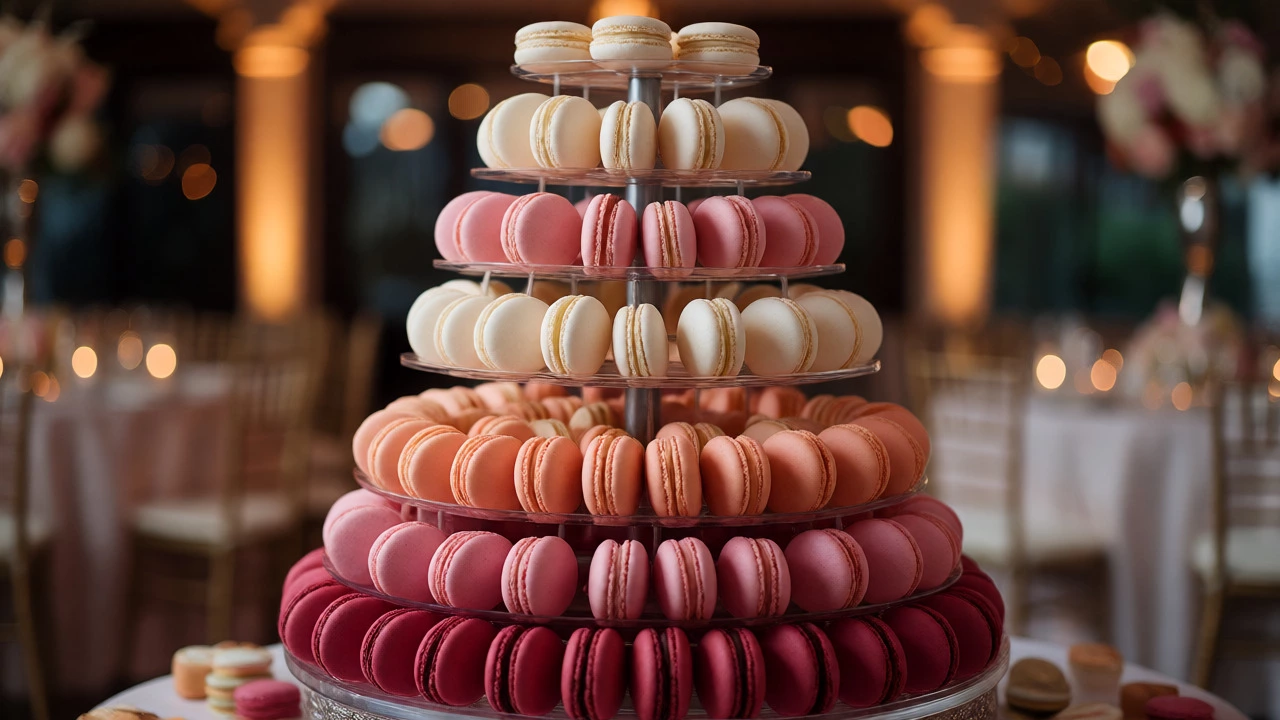
Add those numbers up, and you get a range of 50 to 71 macarons for a standard tapered tower. But wait-that assumes you only fill the top surface. What about the sides? This is where the "Pyramid Method" changes everything.
Surface vs. Pyramid: Choosing Your Filling Strategy
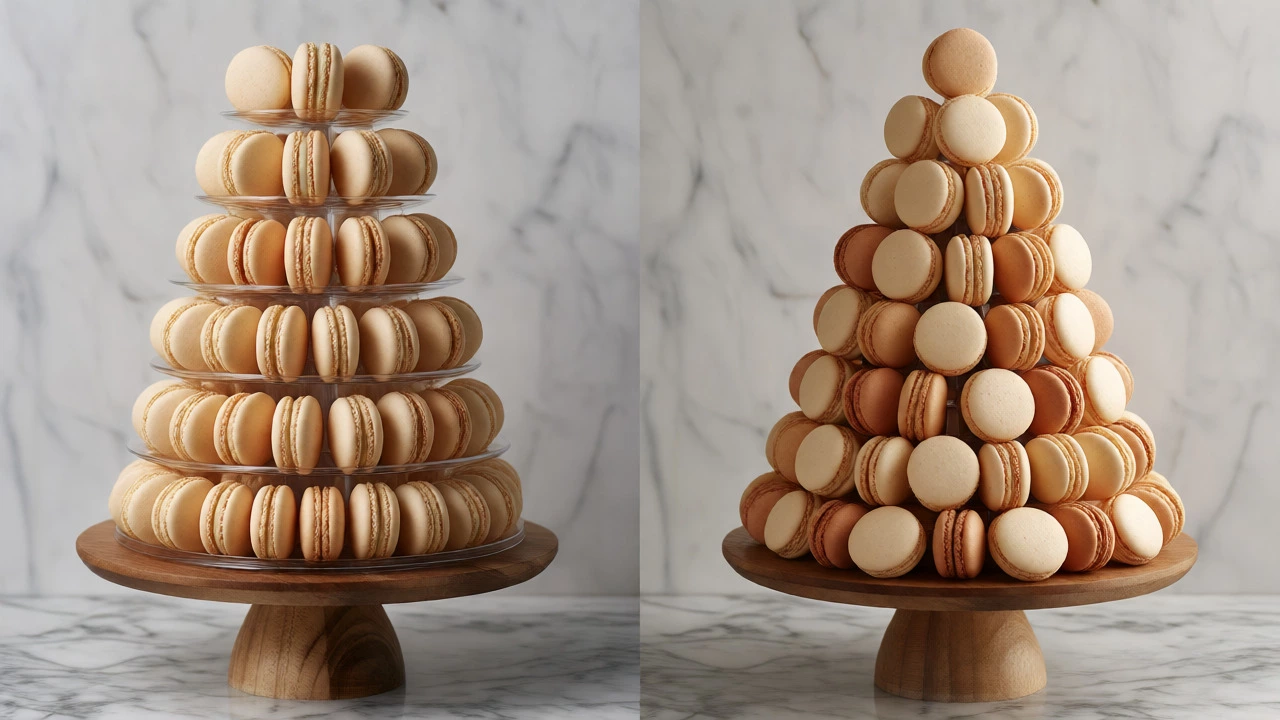
There are two main ways to load a tower, and they drastically change your count. The first is the Flat Surface Method, described above. You lay macarons flat on each disk. It’s clean, easy to stack, and safe for transport. The second is the Pyramid Method, where you build little cones of macarons on each tier, overlapping the shells so they cascade down the sides.
The Pyramid Method looks luxurious and dense, but it doubles or triples your count. Why? Because you’re utilizing the vertical side walls of each tier. On a 12-inch bottom tier, instead of 30 macarons, you might use 60-80 because you’re stacking them in layers that hang over the edge. For a 4-tier tower using the pyramid method, you could easily hit 150+ macarons. However, this requires more glue (royal icing) and is significantly harder to assemble quickly. If you are doing this solo the night before an event, stick to the Flat Surface Method unless you have practiced the pyramid technique extensively.
Structural Integrity: Don’t Let Gravity Win
Here is a fact most DIYers ignore: macarons are heavy relative to their size. A single filled macaron weighs about 15-20 grams. A tower with 60 macarons weighs nearly 3 pounds just in cookies, plus the weight of the stand itself. If you go with the pyramid method and hit 150 macarons, you’re looking at over 6 pounds of sugar and almond flour balanced on a thin central rod.
You need to consider the material of your stand. Acrylic stands are popular because they look invisible, but they can warp under heat if placed near ovens or direct sunlight. Wooden stands offer better friction, helping the macarons stay put without sliding. Metal rods provide the best stability for heavier loads. If you plan to use the high-count pyramid method, ensure your central rod is thick enough (at least 1/4 inch diameter) and securely anchored to the base. A wobbly tower is a disaster waiting to happen.
Real-World Scenarios: Wedding vs. Party Platters
Context changes the calculation. Are you serving this as a standalone dessert, or is it part of a larger candy buffet?
If it’s a wedding reception favor station, you want abundance. Guests will take two or three each. Here, the pyramid method is preferred. Aim for 120-150 macarons on a 4-tier stand. This creates a lush, abundant look that photographs well. Use varied colors to create depth, placing darker shades on the bottom tiers and lighter pastels toward the top to draw the eye upward.
If it’s a birthday party or casual gathering, you might be serving other desserts too. In this case, the flat surface method is sufficient. Aim for 50-60 macarons. This keeps the display neat and prevents waste. You can also mix in other small treats like chocolate truffles or mini meringues on the lower tiers to add volume without increasing the macaron count, which helps balance the visual weight.
Pro Tips for Assembly and Stability
- Use Royal Icing as Glue: Don’t rely on the natural stickiness of the ganache. Pipe a tiny dot of royal icing on the back of each macaron before placing it. This acts as a cement, especially for the pyramid style.
- Chill Before Serving: Assemble the tower at least 2-3 hours before serving. Cold macarons are firmer and less likely to slide. Room temperature macarons become soft and slippery.
- Check for Leveling: Place the empty stand on a level surface. Even a slight tilt will cause the top tiers to drift. Use a bubble level if necessary.
- Transport Carefully: If you must move the tower, remove the top tiers and carry them separately. Reassemble on-site. Transporting a full 4-tier tower in a car is risky; vibrations alone can topple it.
Frequently Asked Questions
Can I use store-bought macarons for a tower?
Yes, but check the diameter. Store-bought macarons often vary in size. Sort them by size before assembly to ensure even spacing. Also, commercial macarons may be softer, so chill them thoroughly before stacking to prevent crushing.
How long does a macaron tower last?
Assembled towers should be consumed within 24 hours for best texture. Macarons absorb moisture from the air, becoming chewy or soggy after a day. Keep them covered with a cloche or plastic wrap loosely draped over the top if not serving immediately.
Do I need special tools to build a macaron tower?
You need a tiered stand, a piping bag with a small round tip for royal icing, and tweezers for precise placement. Tweezers are crucial for the pyramid method to avoid getting icing on the delicate shells.
What is the best shape for a 4-tier tower?
Tapered (conical) shapes are most stable and traditional. Square or hexagonal tiers offer a modern look but require more careful alignment to prevent gaps. Round tiers are easiest to fill evenly.
How do I keep macarons from sliding off?
Ensure the stand is completely dry and free of oil. Use royal icing dots for adhesion. Avoid humid environments, as condensation can make the stand slippery. If using acrylic, wipe it with alcohol before assembly to remove fingerprints and oils.